
AI English Speaking Apps vs Live Human Teachers: Which Actually Builds Spoken English? (2026 Guide for Indian Learners)
Quick answer: AI English apps are excellent for vocabulary, pronunciation drills and low-pressure daily practice. But if your goal is to speak confidently in interviews, office calls and real conversations, a live human teacher still wins, because spoken fluency is built under real social pressure, with feedback that is prioritised for you. The smartest plan for most Indian learners is both: a few minutes of AI practice daily, and regular 1:1 speaking classes with a human.
Why everyone is asking this question in 2026
AI tutors have improved fast. Duolingo now has AI video calls, and apps like ELSA Speak, Speak and dozens of India-focused apps offer "unlimited conversation practice" for a few hundred rupees a month. ChatGPT and Gemini can hold a voice conversation for free.
So it is fair to ask: if an AI can talk to you any time, why pay for a human teacher?
We teach spoken English 1:1 every day, and we use AI tools ourselves. This guide gives you an honest answer, including where AI is genuinely better.
What AI English apps do well?
Let's be fair to the apps first. They are genuinely useful for:
- Unlimited reps. You can practise at 11 pm, on the metro, or for five minutes between lectures.
- Low cost. Many have free tiers. Paid plans cost far less per hour than any human teacher.
- No judgment. Nobody watches you struggle. For shy learners this matters a lot, and research backs it up (more on this below).
- Instant pronunciation scores. Apps that analyse individual sounds can help you drill problem sounds like v/w, z/j or th.
- Vocabulary and grammar drills. Repetition-heavy work is exactly what software is good at.
If you only want to build a word bank or a daily habit, an AI app is a sensible, cheap start.
Where AI apps fall short for spoken English
1. Speaking is the hardest thing for an app to teach
This is not just our view. On Duolingo's May 2026 earnings call, CEO Luis von Ahn described speaking practice as "historically the hardest thing to do well on a mobile app". He also said Duolingo's long-term AI goal is to match the effectiveness of a one-on-one tutor. In other words, even the biggest app in the world treats the 1:1 human tutor as the benchmark.
2. The AI bends to you. Real listeners don't.
An AI never gets bored, never interrupts, never looks confused and never checks its phone while you search for a word. That feels comfortable, but it is not what happens in an HR interview, a client call or a group discussion.
The "freeze" most Indian learners describe, when the mind goes blank in front of a real person, is caused by social pressure. You cannot train for that pressure with a partner who has none.
3. Too many corrections, or the wrong ones
AI feedback tends to be either exhaustive (twelve red marks on one answer) or generic ("Great job! Try to use more varied vocabulary"). A good teacher does something different: they pick the one or two errors that matter most for you this week and let the rest wait.
For example, a student preparing for campus placements may say "I am having two years of experience in Java". A teacher fixes that first (it is noticed in every interview), and ignores a minor article error for now.
4. It doesn't know your context
Indian English has its own perfectly valid features. Prepone, do the needful and revert are understood everywhere in India, but may confuse an American client. Whether you should change them depends on who you talk to. An app trained mostly on American English cannot make that call for you; a teacher who knows your job and audience can.
The same goes for Mother Tongue Influence. A Marathi speaker, a Tamil speaker and a Bengali speaker make different pronunciation errors in English. A trained teacher hears the pattern within one class and builds practice around it.
5. Nobody is waiting for you
Streaks and badges help, but they are easy to ignore. A real person expecting you at 7 pm on Tuesday is the strongest accountability system there is. Most learners don't fail because the method is wrong; they fail because they stop.
What a live 1:1 human-led class gives you
- Real-time adjustment. The teacher sees you hesitate and changes the question, slows down, or pushes harder.
- Pressure in safe doses. You speak to a real person, so you get used to being heard, but in a supportive setting.
- Prioritised feedback. One or two fixes per class that you actually remember and use.
- Goal-specific practice. Mock interviews, client calls, self-introductions, presentations, IELTS speaking: the class is built around what you need next.
- Progress you can feel. Your teacher remembers what you struggled with last week and checks if it's fixed.
AI app vs human teacher: side-by-side
| What matters | AI English app | Live 1:1 human teacher |
|---|---|---|
| Availability | 24/7 | Scheduled slots |
| Cost per hour | Very low or free | Higher |
| Pressure-free practice | Excellent | Good, with a supportive teacher |
| Practice under real social pressure | Weak | Strong |
| Choosing which errors to fix first | Weak | Strong |
| Indian context (MTI, Indian English, workplace norms) | Varies by app | Strong, with an experienced teacher |
| Interview and workplace role-play | Scripted | Realistic, follows your answers |
| Accountability | Streaks and reminders | A real person expecting you |
| Best for | Vocabulary, pronunciation drills, daily habit | Fluency, confidence, interviews, real conversations |
What the research actually says
The research is more balanced than either side's marketing. A 2026 study in the journal Language Learning & Technology compared AI feedback with teacher feedback for 30 university English learners over five weeks of presentations. Both groups reduced their speaking anxiety and improved their presentations. The AI group reduced anxiety more, while performance gains were similar. The authors recommend a hybrid model that uses both.
Our reading: AI is a great low-pressure warm-up. But anxiety going down in front of a screen is not the same as confidence in front of an interviewer. That second step needs real people.
The smart plan: use both
For most learners, we recommend:
- Daily, 10 to 15 minutes, AI app: vocabulary, pronunciation drills, rehearsing answers you'll need.
- 3 to 5 times a week, live 1:1 class: real conversation, role-plays, and targeted correction.
- Weekly, on your own: record a 2-minute voice note on any topic and compare it with last week's.
Which one should you choose?
An AI app alone may be enough if you're building vocabulary, you're a beginner who needs a habit, or you mainly want pronunciation drills.
Choose a human-led class if you have an interview or job change coming up, you freeze in meetings or on calls, you've used apps for months without feeling more confident, or you need English for a specific goal like IELTS, client calls or presentations.
How Speechify.in classes work
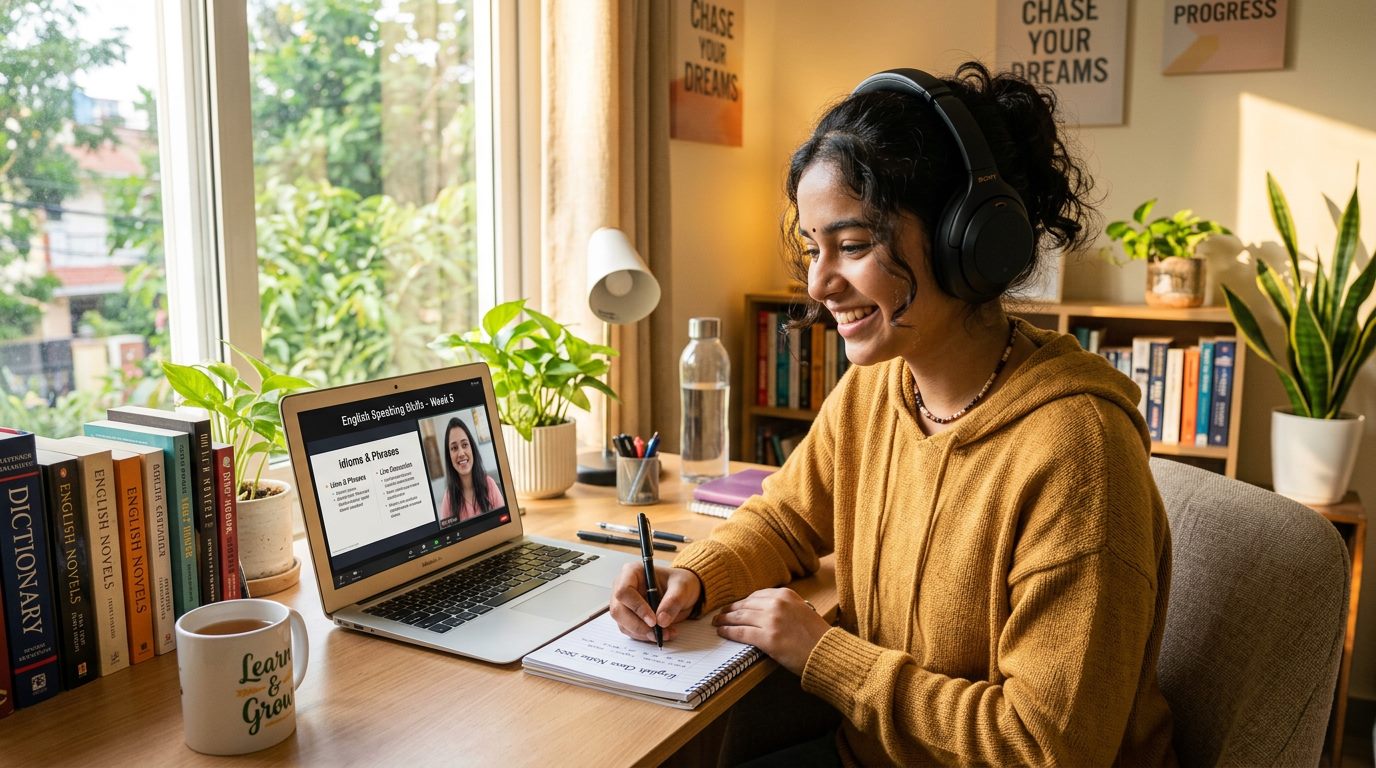
At Speechify.in, every class is live and 1:1 with a trained teacher, on Zoom or Microsoft Teams. Our classes are designed around one rule: you speak for most of the class, not the teacher. Each session is planned around your goal, whether that's interviews, office communication or everyday confidence.
FAQs
Can AI replace an English teacher? Not for spoken fluency, at least not yet. AI is a strong practice tool, but it cannot recreate real social pressure, judge which mistakes matter most for your goal, or hold you accountable the way a person can.
Is Duolingo enough to learn to speak English? Duolingo is good for vocabulary and a daily habit. Its own CEO has said speaking is the hardest skill for a mobile app to teach well. For confident speaking, add live conversation practice.
Are AI English apps good for Indian students? Yes, as a supplement. Choose one that gives pronunciation feedback, and pair it with a teacher who understands Mother Tongue Influence and Indian workplace English.
How many live classes do I need per week? Three to five short, speaking-heavy classes a week usually work better than one long class. Consistency matters more than duration.
Is a 1:1 class better than a group class? For speaking, usually yes. In a 1:1 class you speak for most of the time; in a group of ten, you may speak for only a few minutes.
Ready to speak English with confidence?
Book a free demo lesson with a certified teacher and start speaking from day one.